Toyota Industries Establishes Technological Foundation Toward Spreading the Adoption of Vehicle to Grid (V2G)
~ Confirming applicability of using a bidirectional on-board charger on power grids ~
Toyota Industries Corporation (“Toyota Industries”) has used its bidirectional on-board charger*1 to conduct hardware verification of vehicle to grid (“V2G”) supplying alternating current (AC) power from battery electric vehicles (BEVs) and such to power grids. This verification was conducted jointly with the Research Institutes of Sweden (“RISE”) and Norwegian charger manufacturer DEFA. As a result, based on the requirements of ISO 15118-20*2, the international standard for V2G, it was confirmed that the vehicle can convert the electricity stored in the on-board battery into AC power and supply (discharge) it to the grid. Going forward, Toyota Industries will address the technological issues identified in this verification, and at the same time, enhance technologies related to charging/discharging performance improvement and power control to seek commercialization of bidirectional on-board chargers compatible with V2G.
In recent years, the introduction of renewable energy has been advancing globally. To ensure stable power supply, it is becoming increasingly important to adjust supply and demand imbalances, including fluctuations in power generation due to weather. Amid such circumstances, BEVs equipped with batteries are expected to be utilized for V2G applications, such as storing electricity generated from solar or other power sources during the day and discharging it to the grid at night.
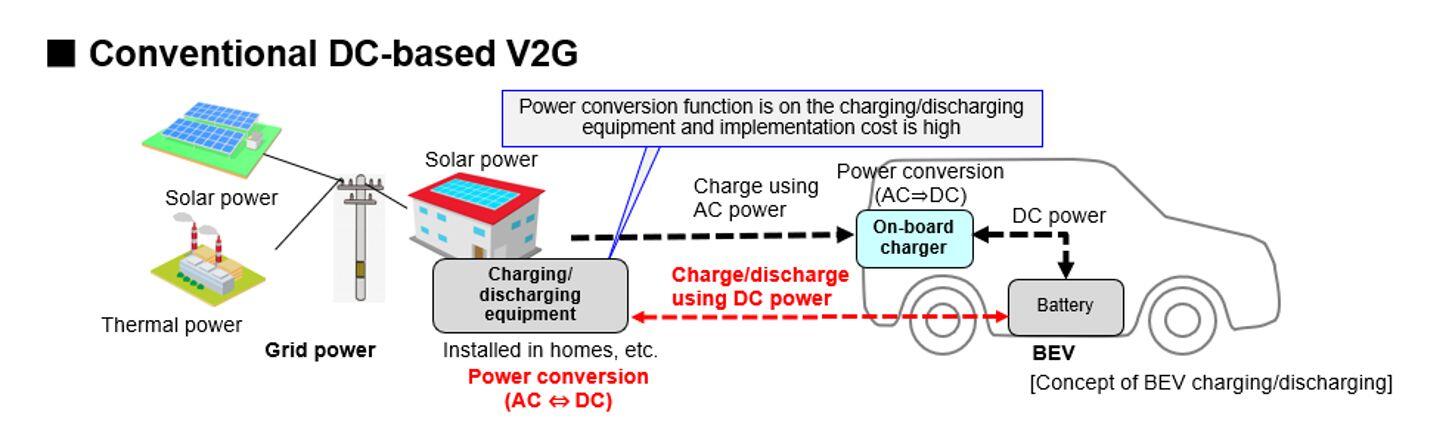
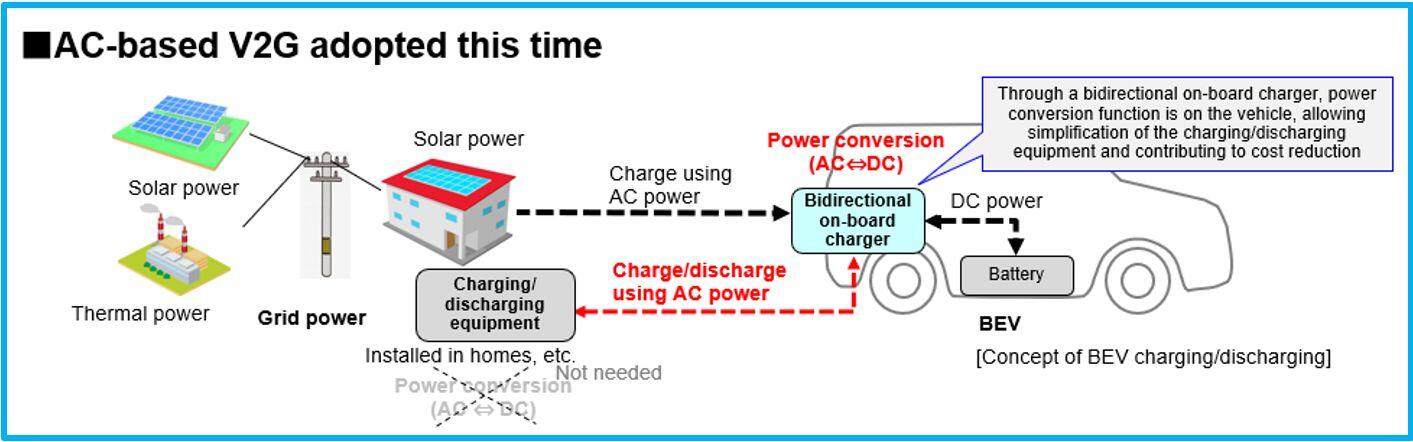
In conventional V2G based on direct current (DC), electricity stored in BEVs is converted from DC to AC using charging/discharging equipment installed in homes and other locations before being discharged into the grid. Meanwhile, the AC-based V2G adopted this time uses an on-board charger that can convert between DC and AC in both directions, allowing vehicles to supply AC power to the grid. This can simplify charging/discharging equipment and reduce implementation costs, contributing to wider adoption in the future.
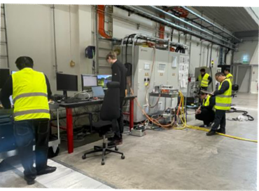
For this verification, Toyota Industries provided its V2G-compatible bidirectional on-board charger, DEFA provided its newly developed charging/discharging equipment, “DEFA Power,” and RISE developed the test environment, conducting evaluations based on international standards. Operational confirmation was conducted on the stable supply of AC power while carrying out power control of the vehicle, charging/discharging equipment, and the grid. The results met the specified criteria in key items such as supply efficiency and resistance to changes caused by external factors, establishing a technological foundation toward spreading the adoption of V2G.
Toward the realization of a sustainable society, Toyota Industries will continue to undertake technological development to help create an environment where BEVs not only serve as a means of transportation but also perform as “moving batteries.”
| *1 | Bidirectional on-board charger: A charger installed in vehicles such as battery electric vehicles (BEVs). It has the functions for converting alternating current (AC) to direct current (DC) to supply power to the on-board battery when charging, and converting the battery's DC power to AC power to supply it externally during discharge. |
| *2 | ISO 15118-20: An international standard regarding communication interfaces for achieving bidirectional power control between electric vehicles and charging/discharging equipment. |